Taxonomy II: Nomenclature
Listen to this reading
Did you know that Tyrannosaurus rex could have been called Manospondylus gigas? The rules of scientific nomenclature usually dictate that when more than one name for a species is discovered has been given, the older one prevails. Luckily, common sense won out in the case of T. Rex, and this most famous dinosaur was allowed to keep the newer name that both scientists and the general public had become familiar with.
Henry Fairfield Osborn was the first curator of vertebrate paleontology at the American Museum of Natural History, in New York, and its first scientist-president. He was hired in 1891, just 15 years after the museum opened. One of Osborn's most famous projects involved the naming and description of what was once only a modestly important dinosaur discovered in Montana, Tyrannosaurus rex. It was gigantic, fierce looking, and extraordinarily popular as an exhibit skeleton mounted in the museum's halls, and Osborn helped make the shorthand label for this fascinating beast, T. rex, a household expression, fitting even to become the marquee of a British rock and roll supergroup of the early 1970s.
More recently, however, after being part of our vocabulary for a century, that name was challenged. Paleontologists recently discovered that the species we know as T. rex had an earlier christening. Manospondylus gigas is its "real" name. The reason? Edward Drinker Cope, a self-taught paleontologist, proposed and published that name in 1892, about a dozen years before Osborn announced T. rex. Since it was based on a single bone, Osborn could not have known that Cope's M. gigas was the same species as his. But with many more fossils that appear to be from the famous "tyrant lizard," what should be done with multiple names?
Goals of the Linnaean naming system
Problems like this, the accidental duplication of names, were obvious to the father of taxonomy, Carolus Linnaeus. His response was to establish a logical, uniform approach to the naming process in the hope that it would be recognized and accepted the world over (see our Taxonomy I: What's in a name? module). Linnaeus knew that the creation of duplicate, different-sounding names for the same species, called taxonomic synonyms, was only one of many barriers relating to names that could impede accurate scientific exchange. Differences in language and culture, the idiosyncrasies of individual scientists, difficulty obtaining the writings of other scientists, unavoidable mistakes such as typographical errors – all can contribute to confusion and a host of problems when identifying and cataloging organisms. Thus, the central idea behind the Linnaean taxonomic system was to provide a stable, enduring list of names so that we can communicate effectively in all the fields of the life sciences, retrieve information efficiently, and be confident that each species name is one of a kind.
The solution that Linnaeus adopted was the consistent use of a two-name system called binomial nomenclature. He recognized that by giving every species a fixed pair of names, analogous to our "family" and "given" names, each one could be designated uniquely. The titles for the two official names were those that John Ray, a British naturalist, had proposed a century earlier, the genus and species. In practice, these terms are tied together and used in combination. The combination is presented as a sequence, first the genus name (plural genera, related to the word generic) and then the species name (plural species, related to the word specific), as in the binomial Homo sapiens.
Taxonomists have also extended this reasoning to employ a three-name set, a trinomial, which applies to the subspecies of a species. Gorilla gorilla gorilla (Western Gorilla) and Gorilla gorilla beringei (Eastern Gorilla) are examples. That scientists still quibble over whether or not the Western and Eastern populations of gorillas ought to be interpreted as different species or merely different subspecies doesn't really matter. As species, they would be known as G. gorilla and G. beringei; as subspecies, we'd call them G. gorilla gorilla and G. gorilla beringei. Trinomials even apply to our own species, as shown by the recent naming of an extinct subspecies from Ethiopia that was based on fossils that are about 160,000 years old. It is called Homo sapiens idaltu to contrast it with all of us modern people – Homo sapiens sapiens.
Comprehension Checkpoint
Other rules for naming species
For clarity and consistency, there are other rules governing the naming of species, among them:
- Generic and specific names are italicized when typewritten.
- The first letter of the genus name is always capitalized, while the species name is entirely lowercase.
- Species names are constructed in the Latin form, in the tradition of the early European taxonomists.
- When more than one name is attributed to a single species, the oldest published synonym name takes precedence over others.
Of course, the rules of Linnaean nomenclature apply only to official names, not to informal, everyday language, which is virtually impossible to track and enforce. Thus an informal reference to a species is simply written lowercase in plain text (e.g., gorilla) while a formal reference, for example to the genus, would appear in italics (e.g., Gorilla). As you have probably noticed, our gorilla example is also an unusual case of taxonomic nomenclature, where the common name and the scientific name are one and the same. It is also unusual for its historical simplicity – the formal genus name, Gorilla, has a fairly straightforward history, much less complicated than the story of the name for chimpanzees, Pan, as you see from the table below. Gorillas have only been given two generic (i.e., genus) names, and the oldest is easily decided as the proper one for us to use. Chimpanzees, on the other hand, have been given at least 11 different generic names. Its first name, Troglodytes (also once used for gorillas), is not the one we use today because before it was applied to chimps, it was given to a very successful bird, the wren, Troglodytes troglodytes. The tiny wren trumps the chimp in this case, since the rules of zoological nomenclature apply equally to all animals.
Comprehension Checkpoint
Examples of conflicts among scientific names
|
Genus Gorilla (I. Geoffroy, 1853) 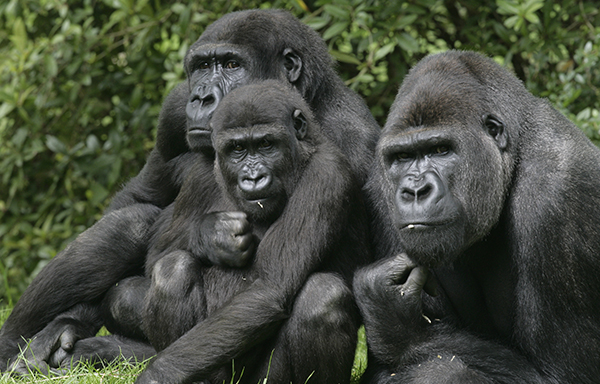
|
|
| 1853 | Gorilla I. Geoffroy, based on Troglodytes gorilla (Savage and Wyman, 1847) |
| 1913 | Pseudogorilla Elliot, based on Gorilla mayema (Alix and Bouvier, 1877) |
|
Genus Pan (Oken, 1816) 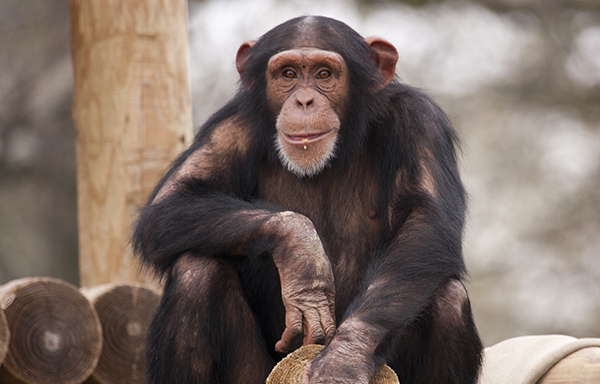
|
|
| 1812 | Troglodytes E. Geoffroy, based on Troglodytes niger (E. Geoffroy, 1812) |
| 1816 | Pan Oken, based on Pan africanus (Oken, 1816) |
| 1828 | Theranthropus Brookes, based on Troglodytes niger (E. Geoffroy, 1812) |
| 1841 | Hylanthropus Gloger, based on Simia troglodytes (Blumenbach, 1799) |
| 1860 | Pseudoanthropus Reichenbach, proposed as a replacement for Troglodytes |
| 1866 | Engeco Haeckel, based on Simia troglodytes (Blumenbach, 1799) |
| 1866 | Pongo Haeckel, replacement for Troglodytes |
| 1895 | Anthropithecus Haeckel, correction for Anthropopithecus |
| 1905 | Fsihego de Pauw, based on Fsihego iturensis(de Pauw, 1905 |
When we use formal taxonomic names in the literature, the names themselves are often accompanied by a compact citation that identifies its author and date of publication, like this: Gorilla gorilla gorilla (Savage, 1847). Which brings us back to Henry Fairfield Osborn and his unavoidable nomenclatural faux pas. Tyrannosaurus rex (Osborn, 1905) is a name that breaks one of the cardinal rules of taxonomy, the principle of priority, which requires that in cases where taxonomic synonyms are known to occur, the first name given to a species is recognized as the authentic one. The bottom line for T. rex is that it is not being replaced by its older synonym, Manospondylus gigas (Cope, 1892), for a more practical reason: It is so familiar to us all. Consider how much confusion a taxonomic change would bring to the world of science, where T. rex is an accepted name, and to the culture at large, where T. rex is one of the world's most famous dinosaurs.
One of the interesting lessons this situation highlights is the way scientists voluntarily abide by Linnaean practices. This is not simply to avoid the chaos that would occur if they did not. When scientists describe new species, they do so in a journal article or other form of publication, and that work is subject to review by their peers (see our Module on Peer Review in Scientific Publishing. If scientists were to disregard a well-established procedure, their peers would likely not allow it to be published. Disputes and questions over Linnaean names can still arise, but most resolve themselves in the literature, where scientists present not only their research about species biology and evolution but also historical information about taxonomic names – all in an effort to keep the names straight. In cases where confusion persists, or adhering to the rules might upset the stability of names, scientists may petition one of the decision-making bodies recognized by scientists around the world for an exception to the rules. These commissions also introduce changes to the taxonomic code from time to time.
On January 1, 2000, one such amendment written by the International Commission on Zoological Nomenclature came into effect. In the spirit of Linnaeus, always hoping to maintain the stability of taxonomic names, a new ruling upheld the common sense solution to the dilemma of Tyrannosaurus vs. Manospondylus. The Commission provided a clear, legal definition of what is meant by general acceptance, as opposed to rare usage, of a taxonomic name. If a name is in use for 50 years, it does not have to revert to a rarely used prior name that may be lurking in the shadows. Osborn's T. rex has been among us, called by that name, for a hundred years, almost as long as Manospondylus gigas lay quietly buried in the literature. So, wisely – or might it be expectedly? – the challenge to the reign of Tyrannosaurus rex has bitten the dust.
Comprehension Checkpoint
Brontosaurus: A case of mistaken identity
In contrast, the name of another giant, Brontosaurus (Marsh, 1879), has been sunk, as taxonomists are apt to say, when a replacement name wins out. It was changed to Apatosaurus (Marsh, 1877). Both terms were widely used for a long time but here, too, paleontologists learned recently that the bones bearing those names actually came from one species. The oldest name for that species is Apatosaurus ajax.
The consensus among paleontologists is that a name change in this case would not be too upsetting, and the giant herbivore's more familiar name "Brontosaurus" has been set out to pasture. As further insult to this case of mistaken identity, Apatosaurus is also suffering a required cosmetic makeover. For decades this gigantic animal, originally found headless, was displayed grandly and whole at the American Museum of Natural History and elsewhere, but with the wrong face. During the 1970s, paleontologists finally were able to match up skulls and skeletons with certainty, only to prove what was long suspected. The tiny heads chosen long ago as a best fit to crown those gigantic bodies were accidental imposters: They belonged to another dinosaur called Camarasaurus. So, "Brontosaurus," who is actually Apatosaurus, got its head size fixed and a new name as well, because even giants have to follow the rules.
Table of Contents
Activate glossary term highlighting to easily identify key terms within the module. Once highlighted, you can click on these terms to view their definitions.
Activate NGSS annotations to easily identify NGSS standards within the module. Once highlighted, you can click on them to view these standards.